How Can I Scale a Prepared Rice Cup Line Without Losing Fill Accuracy, Seal Quality, or Margin?
Your trial cups look great. Mass production starts, rejects rise, and margin disappears. Most failures come from line architecture, not operator mistakes.
If you buy prepared rice cup equipment, the core question is not only speed. The real question is system fit: cup geometry, product rheology, thermal process, and sanitation strategy must be designed together from day one.
At Guangdong Xinchuang Machinery Industry Co.,Ltd, we build export-oriented cup filling and sealing systems. I will share how we evaluate prepared rice cup projects before signing a contract, including where the line is not suitable.
Why does cup diameter lock the whole prepared rice cup system?
In real projects, buyers often ask for “one line for many SKUs.” I understand the business logic. But on cup lines, diameter is not a small parameter. It is a structural decision. Your [cup diameter mold]1 affects denesting, indexing pitch, filling centerline, sealing head layout, transfer starwheel, and downstream cartoning pocket geometry. This is why mold switching is costly and affects the whole system.
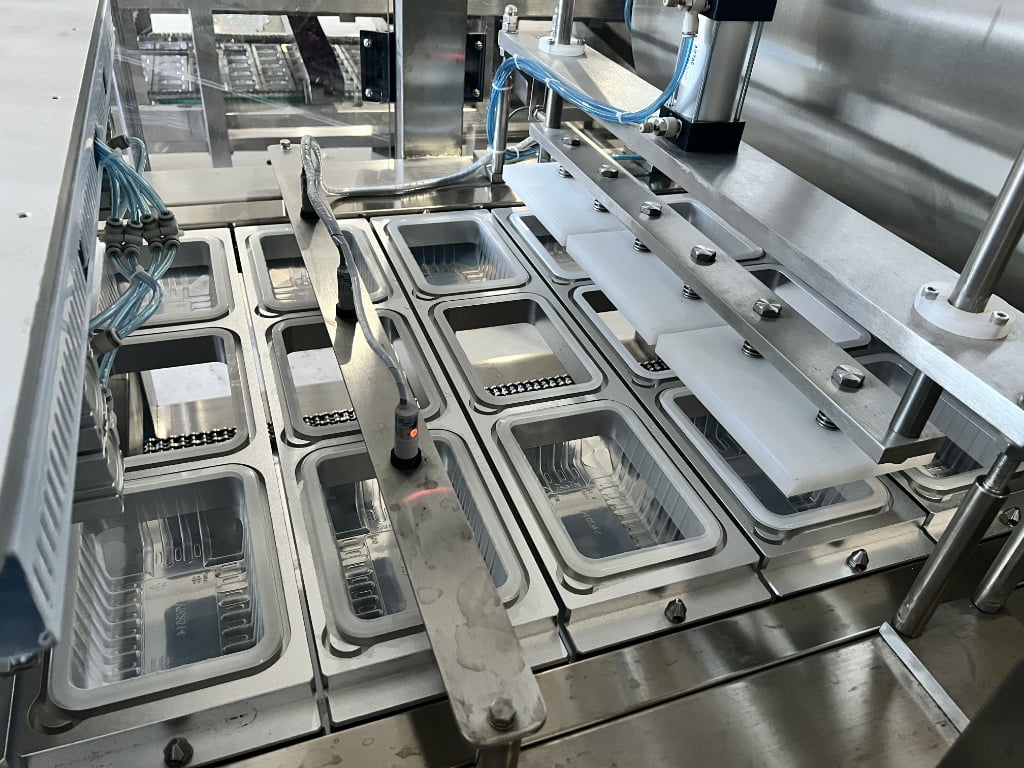
From factory-side experience, the hidden cost is not just mold price. It is changeover time, alignment verification, startup scrap, and reduced OEE in the first production hours after changeover. When diameters differ too much, we usually recommend separate modules or separate lines, even if nominal speed is lower. The total weekly good output is often higher.
I usually ask buyers to freeze three numbers early: cup top diameter tolerance, cup height tolerance, and flange flatness window. If these are not controlled with your cup supplier, we cannot stabilize sealing yield. You may blame machine temperature, but root cause is often cup variation outside tool design assumptions.
Trade-off example: one customer wanted 72 mm and 95 mm cups on one chassis. Technically possible, yes. Economically efficient, not always. The larger pitch reduced cavity count, so throughput dropped. Also, seal head replacement required longer warm-up and qualification. In this case, we proposed one main line for 95 mm prepared rice cups and a compact auxiliary machine for 72 mm promotional SKUs. Capital cost increased slightly, but unit cost and planning stability improved.
If you are still in packaging design phase, I suggest you confirm diameter strategy before machine FAT. Late changes at this stage create expensive mechanical rework and delayed shipment.
How do we balance rice texture, sauce viscosity, and filling accuracy at speed?
Prepared rice cup filling is not equivalent to water cup filling. We are handling particles, starch, oil, and often a multi-component recipe. A standard liquid [filling nozzle]2 can shear grains, clog with sauce particulates, or cause tail drip that contaminates the seal area. Seal contamination is one of the fastest ways to destroy line efficiency.
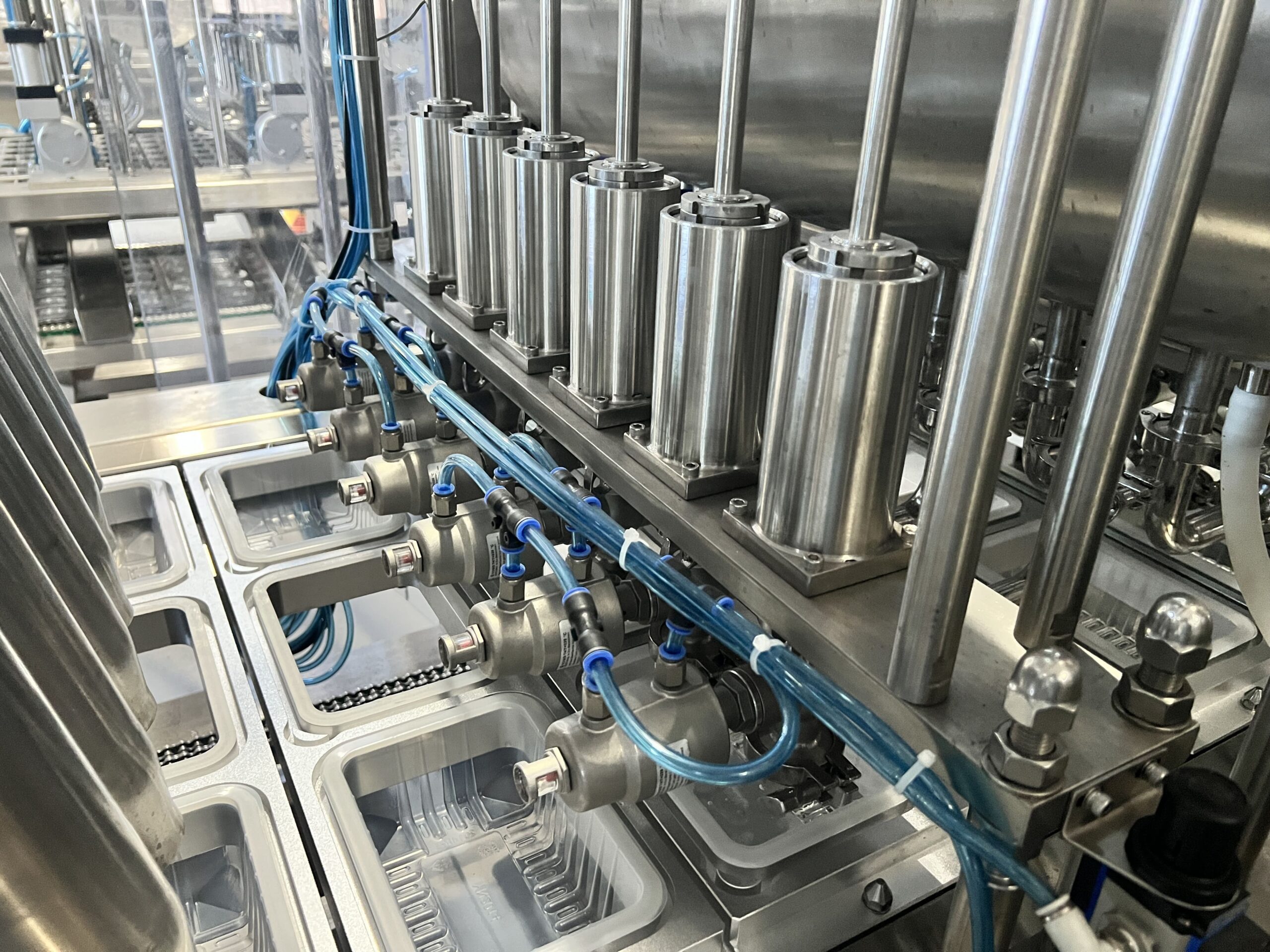
In our projects, we split dosing into stages when needed: rice base first, then sauce, then optional garnish. This increases mechanical complexity but protects product structure and improves weight consistency. If your brand promise depends on visible ingredients, this matters more than absolute max speed.
Engineering trade-offs we see frequently:
- Higher speed vs. deposit stability: faster indexing gives less settling time. Sauce can splash and reach flange.
- Nozzle diameter vs. accuracy: larger nozzle reduces clog risk but can increase drop variance on low setpoints.
- Product temperature vs. viscosity: warm sauce flows better but may soften rice texture before sealing.
- Servo precision vs. maintenance burden: higher-spec drives improve repeatability but raise spare-part cost and technician skill requirements.
For the lidding step, [sealing film]3 selection is not a purchasing afterthought. Film stiffness, heat-seal layer chemistry, and print registration behavior affect seal strength and visual quality. I often see projects fail because the machine is tuned with one film lot, then production switches supplier without revalidation. We tell buyers to define an approved film matrix and run seal window tests (temperature, pressure, dwell) for each lot family.
Unsuitable scenario: if your recipe includes large, irregular chunks (for example, big vegetable cubes) and you require ultra-high speed in small cups, a rotary intermittent cup line may struggle to keep both cleanliness and weight control. In such cases, a lower-speed linear architecture or a different package format can be more honest and profitable.
What thermal and hygiene controls really protect shelf life?
Many buyers ask for “long shelf life” as one sentence. In practice, shelf life is an integrated result of thermal profile, filling hygiene, seal integrity, and post-process handling. For prepared rice cups, we frequently integrate a cooker/pasteurizer interface and carefully control product hold and transfer conditions through sanitary piping and validated cleaning routines.
The process side usually includes a [heat exchanger]4 and holding section before filling, then controlled transfer to the depositor. On controls, we use tuned [PID control]5 loops for product temperature and sometimes jacket temperature, because unstable thermal input causes viscosity swings and inconsistent fill behavior. This is not theory; we have seen 2–3 g weight drift purely from thermal instability during long runs.
Hygiene is where many budget quotes look good on paper but fail during operation. Your line should include validated drainability, dead-leg minimization, and suitable [CIP valve]6 placement for reliable cleaning cycles. If your recipe contains oil and starch, weak CIP design causes biofilm risk and flavor carryover. Then you lose both food safety confidence and production flexibility.
Honest constraints: a fully hygienic, easy-clean design is not the cheapest machine. It can increase initial cost, footprint, and utility consumption. But for exporters or multi-SKU operations, lifecycle value is usually higher due to fewer contamination events and shorter recovery after sanitation.
I also caution buyers on utility assumptions. Compressed air quality, steam stability, and chilled water capacity directly affect performance. If utilities are unstable, even a good machine behaves badly. We always ask for utility data before final design freeze.
When is a prepared rice cup filling and sealing line the wrong investment?
Not every buyer should install this line now. I say this clearly in early meetings because wrong-fit projects damage both sides.
If your volume forecast is uncertain and monthly demand swings heavily, contract packing may be safer for the first stage. In-house automation makes sense when your SKU portfolio, cup specification, and distribution plan are stable enough to absorb fixed costs.
If you plan frequent diameter changes, this line may become an operational bottleneck. As noted, mold switching is not just a quick tooling swap. It can involve re-centering, recipe re-qualification, and startup scrap. If your business model relies on weekly diameter changes for promotions, you should consider separate dedicated assets or rethink SKU structure.
If your raw cup and film suppliers cannot hold tolerances consistently, equipment upgrades alone will not fix rejection rates. We can compensate within a range, but we cannot control external packaging variability beyond machine design limits.
If your team does not have basic preventive maintenance discipline, high-speed machinery will not deliver promised uptime. We provide training and manuals, but execution on site matters. Long service life is real only when lubrication, calibration, seal-head inspection, and sanitation SOPs are implemented.
Finally, if your product needs true aseptic ambient shelf life for long export transit, a standard pasteurized cup line may be the wrong technical route. You may need a different process and package architecture. I prefer to say “not suitable” early rather than oversell and fail later.
We build customizable systems with stable operation and long service life, but good outcomes depend on engineering fit, not brochure speed.
Reliable prepared rice cup production comes from disciplined choices: fixed diameter strategy, validated thermal-hygiene design, and realistic SKU planning. Optimize the system, not one machine headline.
Footnotes
-
cup diameter mold — https://www.kiefel.com/en/technologies/thermoforming ↩
-
filling nozzle — https://en.wikipedia.org/wiki/Nozzle ↩
-
sealing film — https://www.amcor.com/products/packaging-films/lidding ↩
-
heat exchanger — https://en.wikipedia.org/wiki/Heat_exchanger ↩
-
PID control — https://en.wikipedia.org/wiki/PID_controller ↩
-
CIP valve — https://www.alfalaval.com/products/fluid-handling/valves/single-seat-valves/ ↩