
When Should a Sauce Cup Machine Use Piston Filling Instead of Gravity Filling?
Sauce cup filling is not only a question of choosing a nozzle and setting a volume. The product must move from the hopper, through the dosing system, and into every cup within the available machine cycle. If the sauce flows too slowly under its own weight, a gravity system can become the bottleneck even when the rest of the machine is designed for higher output.
Direct answer: a sauce cup machine should use piston filling when the product has low flowability, higher viscosity, or needs pressure-assisted dosing to maintain both production speed and filling accuracy. Gravity filling is normally suitable only for fast-flowing, low-viscosity liquids without particles, such as clear fruit juice or water-like products.
First, Correct the Terminology
The original comparison “piston filling versus pump filling” is technically misleading. A piston filler is itself a positive-displacement dosing system: movement of the piston creates a defined chamber volume, draws product into that chamber, and then pushes the product toward the filling nozzle. The useful factory comparison is therefore pressure-driven piston filling versus gravity filling.
Gravity filling relies mainly on liquid head and the product’s ability to flow through the valve and nozzle. Piston filling actively moves a measured volume. This difference becomes important when resistance to flow increases. The NIST explanation of rheology defines viscosity as resistance to flow and notes that some materials also have a yield stress, meaning that force is required before flow begins.1
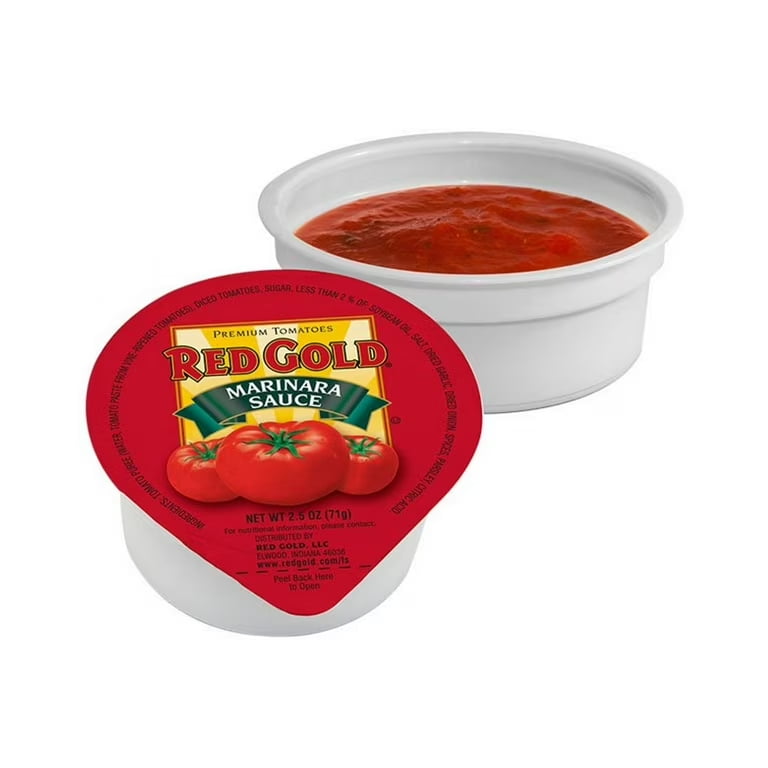
In real sauce projects, one viscosity number is not enough. Ketchup, chili sauce, mayonnaise, jam, marinara sauce, and sauces with vegetable or spice particles can behave differently under pressure. Temperature, recipe, shear, particle content, and waiting time can all change how a sample fills. This is why Xinchuang asks for actual product information and normally recommends sample checking before the final filling structure is confirmed.
When Pressure-Driven Piston Filling Is the Better Choice
According to Xinchuang’s factory experience, thick sauce has lower flowability and normally moves more slowly than juice or water-like products. If it is left to gravity alone, the filling time can become too long to match the intended machine speed. A piston system applies controlled pressure during discharge so the product can reach the cup within the available cycle.
Low flowability limits the machine rhythm
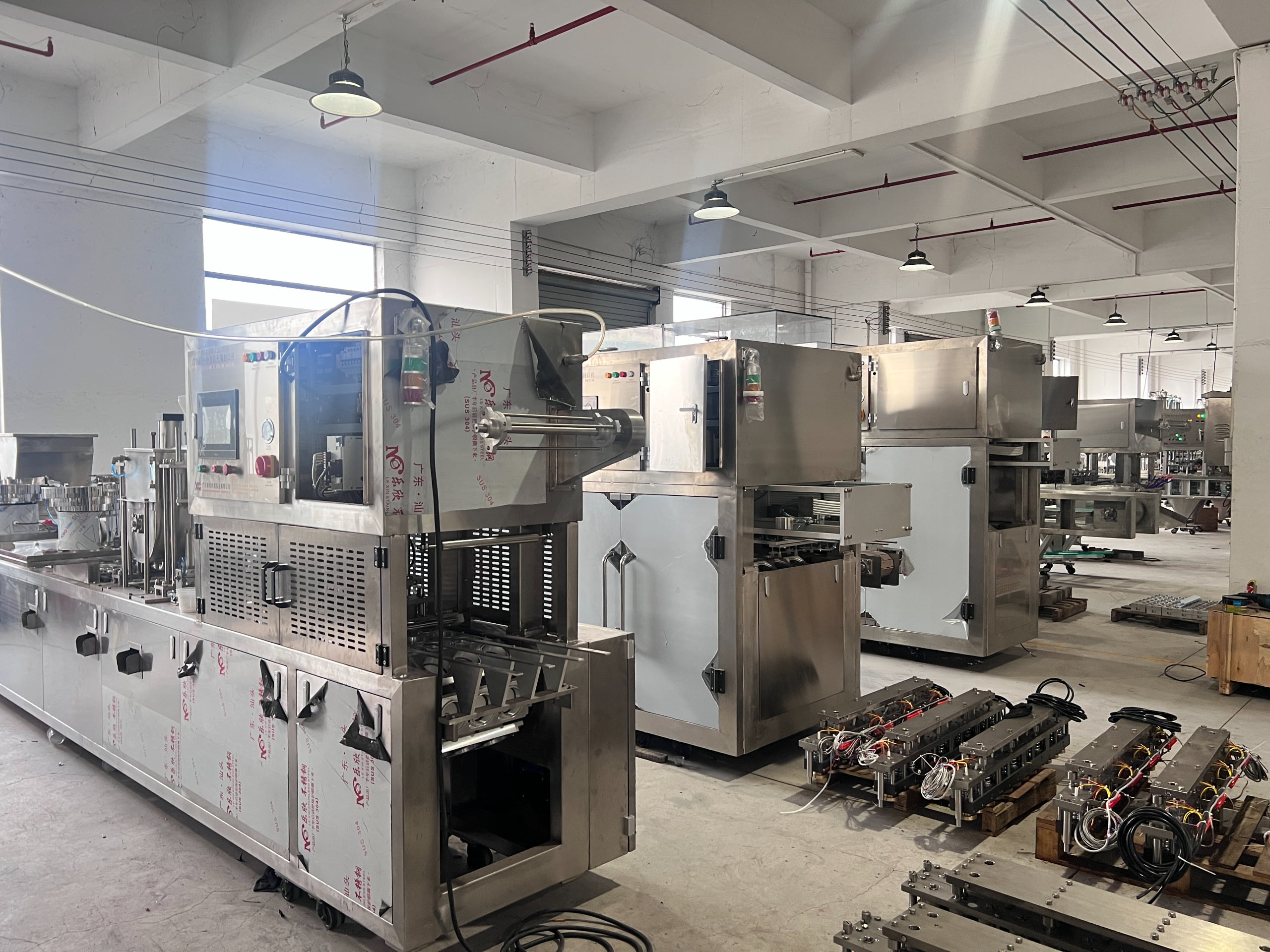
A linear cup filling and sealing machine works station by station. Cups are dropped, indexed, filled, covered, sealed, coded, and discharged according to one coordinated rhythm. If the sauce needs too much time to pass through a gravity nozzle, the entire machine must wait. Increasing the number of lanes cannot solve a filling system that is fundamentally too slow for the product.
The Tetra Pak Dairy Processing Handbook section on pumps explains that higher-viscosity liquids create greater resistance to flow and can reduce flow rate while increasing power demand.2 Although that source discusses process pumps rather than Xinchuang’s cup filler, the underlying flow principle helps explain why a water-like filling approach cannot simply be copied for sauce.
Controlled displacement supports repeatable dosing
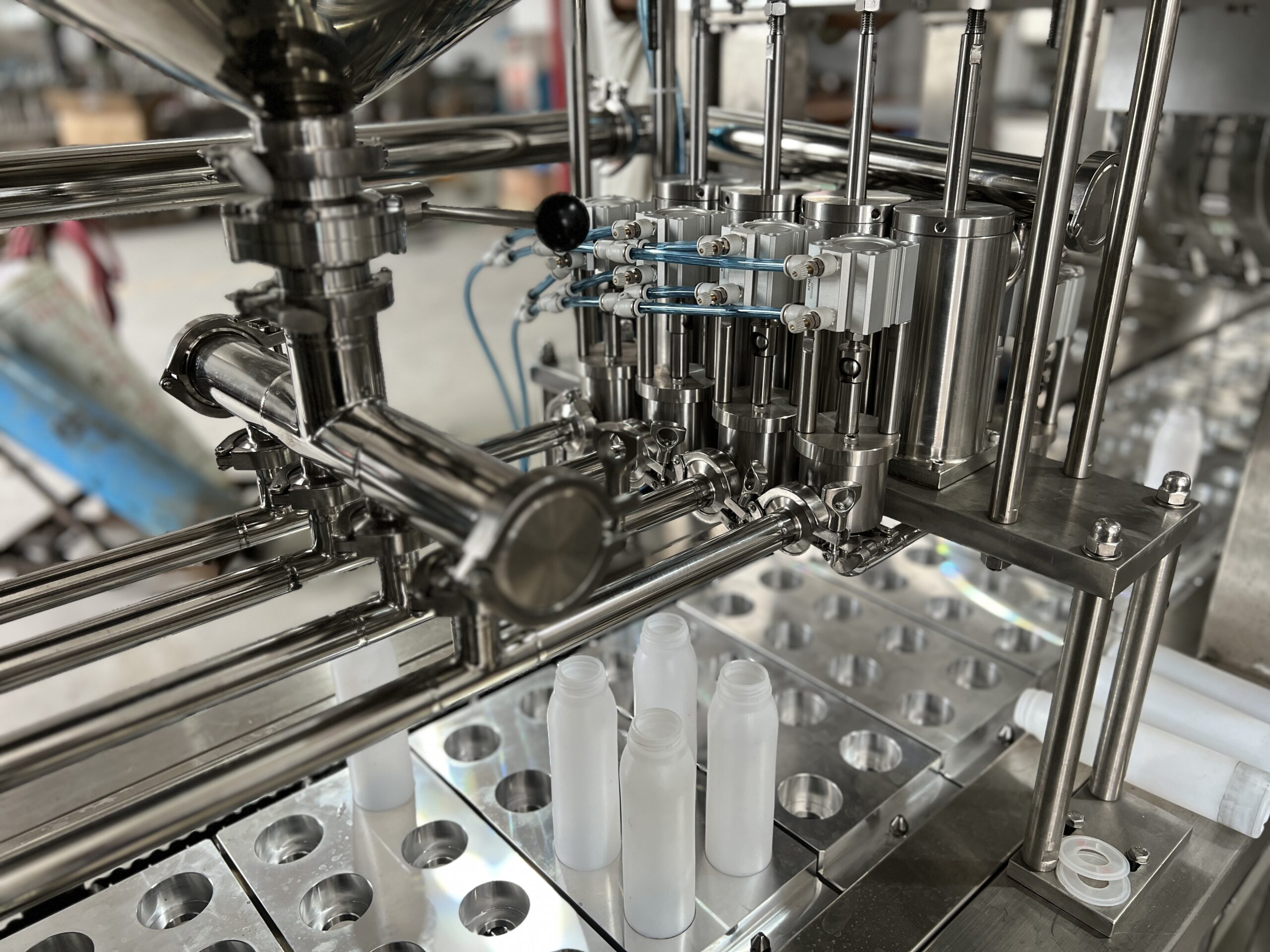
The piston chamber creates a controlled displacement for each cycle. Properly configured, this makes it easier to tune the target dose for a thick but flowable sauce than relying only on how quickly the product falls under gravity. It does not guarantee perfect accuracy under every condition. Air pockets, an inconsistent hopper level, worn seals, unsuitable valves, temperature changes, particles, or sauce that strings at the nozzle can still affect the result.
Industrial equipment suppliers use piston dosing for other viscous food applications for similar reasons. For example, GEA describes volumetric piston injectors for accurate dosing of jams, creams, and sauces.3 The exact GEA equipment is different from a sauce cup machine, but it illustrates the broader role of piston dosing in controlled viscous-food filling.
When Gravity Filling Can Be Suitable
Gravity filling can be a practical solution when the product flows rapidly and consistently without applied pressure. Typical examples are water-like beverages and clear fruit juices with low viscosity and no particles. Under these conditions, the filling valve can open, allow the liquid to flow into the cup, and close within the required cycle.
Gravity filling should not be selected for a sauce merely because its equipment appears simpler. If the product flows too slowly, the machine may miss the required dose unless the filling time is extended. Extending that time reduces output. Trying to compensate with a larger opening can create poor cutoff, splashing, dripping, or cup-rim contamination.
Particles are another boundary. A clear liquid and a sauce containing chili flakes, seeds, fruit pieces, herbs, or vegetable pieces do not behave the same way through a valve. Particle dimensions and distribution must be compared with every product-contact passage. The Alfa Laval Pump Handbook distinguishes common applications for low-viscosity centrifugal pumping from positive-displacement pumping used for sauces, concentrates, and products that may contain particulates.4
| Decision factor | Piston filling | Gravity filling |
|---|---|---|
| Typical product behavior | Thick but flowable; needs pressure assistance | Thin, fast-flowing, water-like |
| Suitable examples | Ketchup, mayonnaise, chili sauce, jam, thick dressings, depending on recipe | Clear fruit juice, cup water, and similar low-viscosity liquids |
| Particles | Possible only when valve and nozzle passages are designed and tested for them | Normally selected for particle-free liquids |
| Dosing principle | Controlled piston displacement pushes product to the nozzle | Product flows from the tank under gravity |
| Main production risk | Wrong passage size, air, wear, stringing, or unsuitable product can affect dosing | Slow flow can reduce speed and cause underfilling or unstable cutoff |
| Validation | Actual sauce sample and target volume should be tested | Confirm free flow, no particles, valve cutoff, and filling time |
How Filling Choice Affects Accuracy and Speed
Accuracy and speed are connected. A buyer may ask for a high output and a tight filling tolerance, but the dosing method must physically move the required volume during each cycle. For a thick sauce, pressure filling helps the machine reach the target volume without waiting for slow gravity flow. If the filling time remains too long, the realistic choices are to change the filling circuit, increase the number of filling lanes, reduce the target line speed, or adjust the product condition after technical review.
No supplier should promise the final output from viscosity alone. The cup diameter controls how many cups can be arranged across the machine; the filling volume controls how much product must move per cycle; and the sauce determines the required piston, valve, pipe, and nozzle arrangement. Buyers should therefore evaluate output together with cup size and machine layout.
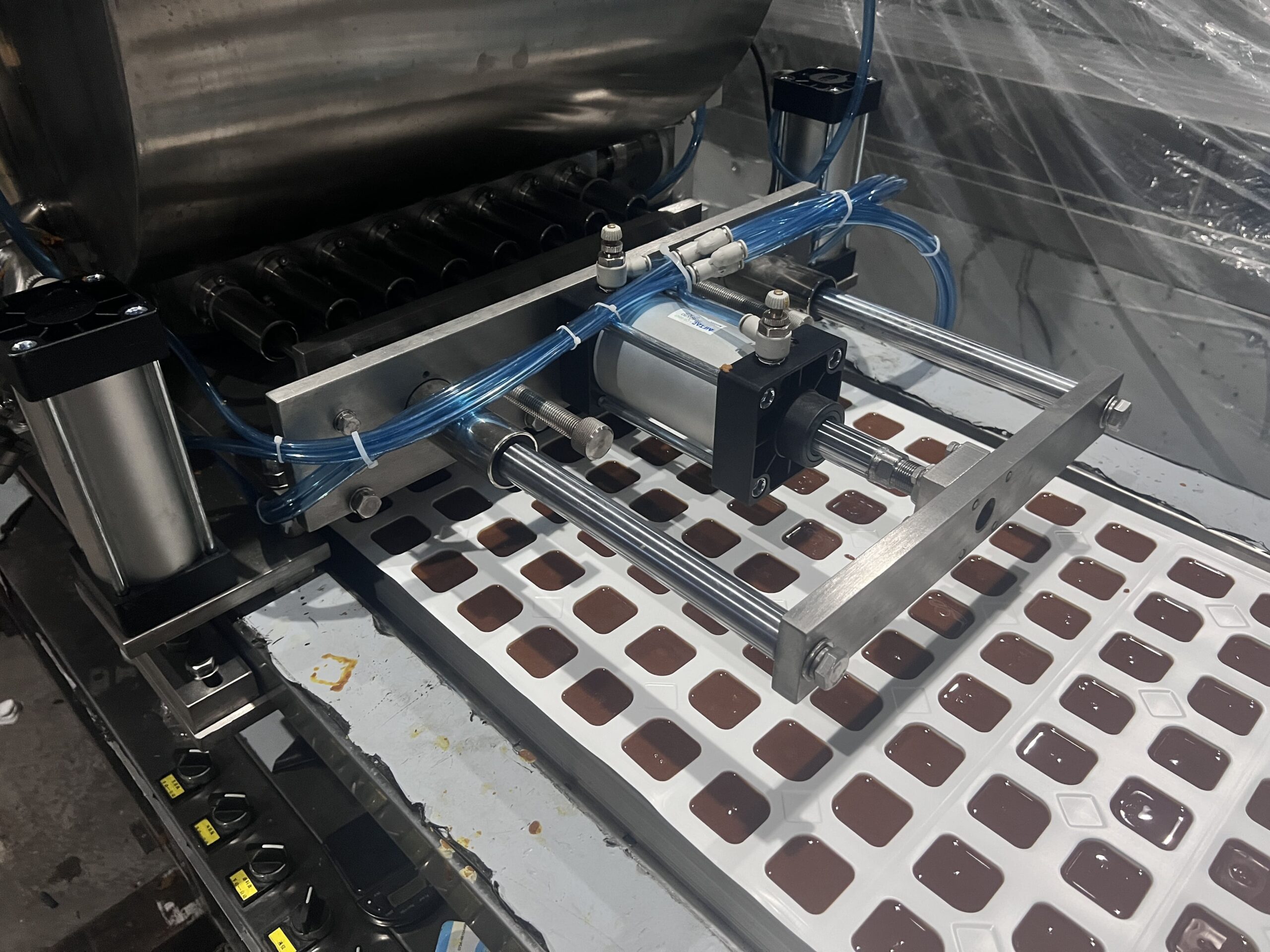
Cutoff behavior also matters. A sauce that forms strings or continues to drip after the piston stroke can contaminate the cup rim. Once product reaches the rim, sealing quality may become unstable even when the sealing temperature and pressure are correct. Anti-drip nozzles, nozzle height, filling profile, and product consistency may need adjustment according to the sample.
What Must Be Confirmed Before Machine Design
A reliable machine recommendation requires more than the label “sauce.” The buyer should provide the actual product, package, and production conditions. A factory making smooth ketchup has different requirements from one filling mayonnaise, jam, or chili sauce with visible particles.
| Information to provide | Why it changes the machine | How to confirm it |
|---|---|---|
| Actual sauce sample | Shows flowability, stringing, dripping, air behavior, and response to pressure | Test a production-representative sample |
| Particle type and maximum size | Affects valve, pipe, and nozzle passage dimensions | Measure the largest real particles, not only the average |
| Filling temperature | Can change viscosity and flow during production | State the normal and expected operating range |
| Cup drawing and physical samples | Controls cup holders, filling position, lanes, and sealing alignment | Send drawings, cups, and sealing material |
| Target volume and output | Determines product volume per cycle and the required number of filling positions | Provide normal dose, maximum dose, and hourly target |
| Cleaning method | Changes product-contact design, accessibility, and CIP or manual-cleaning interfaces | Define the buyer’s cleaning procedure and factory connections |
For hygienic food equipment, the pump and valves must also be considered as cleanable product-contact components. EHEDG Guideline 17 covers hygienic requirements for several pump types, including piston pumps, and emphasizes hygienic application in food processing.5 The buyer and supplier must still define the exact cleaning boundary for the selected cup filling machine.
Xinchuang recommends sending samples before finalizing the design. The reasons are explained further in why buyers should send real package and product samples. A broader sauce-machine selection guide is also available in How to Choose a Sauce Cup Filling and Sealing Machine for Thick Products?
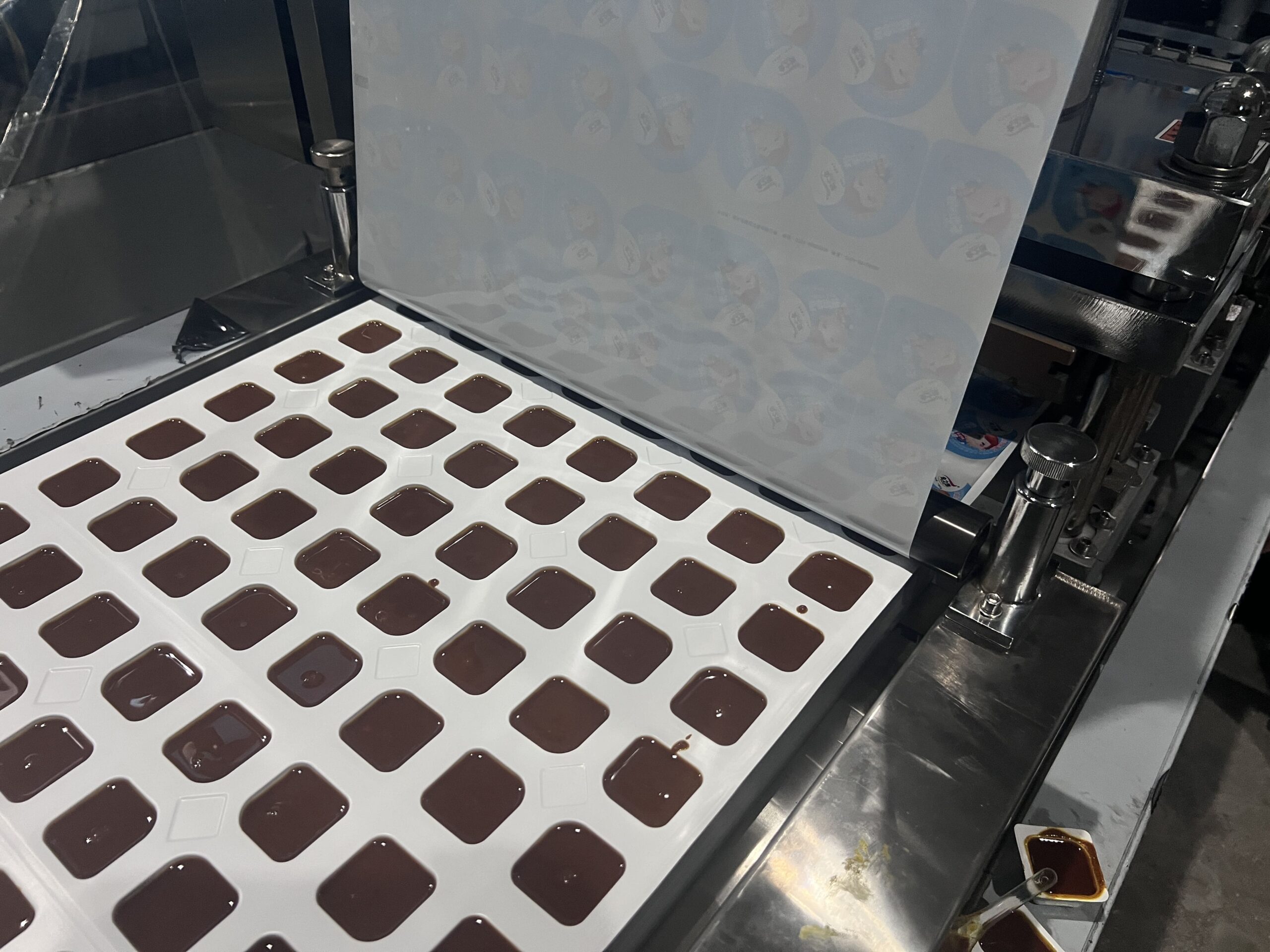
Buyer Checklist
- Confirm whether the product flows freely under gravity or needs pressure to move at production speed.
- Provide an actual sauce sample at the intended filling temperature.
- State whether the recipe contains seeds, flakes, pulp, fruit pieces, herbs, or other particles.
- Give the maximum particle size and expected distribution.
- Confirm cup diameter, height, rim shape, filling volume, and sealing material.
- Define the required hourly output and normal production shift.
- Agree on the filling-accuracy test and acceptable inspection method.
- Confirm the product-contact cleaning method and CIP or manual-cleaning boundary.
Not Suitable When
Gravity filling is not suitable when the sauce flows too slowly to complete the dose within the machine cycle, when particles may block the selected valve or nozzle, or when unstable flow creates unacceptable filling variation. A standard piston configuration is also not automatically suitable for a nearly non-flowing paste, oversized or fragile particles, or a product that changes substantially during the production shift. These cases require sample testing and may need a different hopper, valve, nozzle, agitation, feeding, or dosing arrangement.
Factory Insight
The most common planning mistake is to separate filling speed from product behavior. Buyers may request a certain number of cups per hour, but a thick sauce cannot be expected to fall through a gravity nozzle at the same rate as fruit juice. Pressure-driven piston filling is used because it helps move low-flowability sauce fast enough to match the line while maintaining more controlled dosing.
The second mistake is assuming that “piston filling” alone completes the design. In practice, the piston, valve, pipe, nozzle, hopper, lane count, cup opening, product temperature, particles, and cleaning method must work together. Final design should be confirmed only after Xinchuang checks the buyer’s production requirements and representative samples.
Conclusion
A sauce cup machine should use piston filling when gravity cannot move the product quickly and consistently enough to meet the required accuracy and production rhythm. Gravity filling remains useful for thin, fast-flowing, particle-free liquids, but it should not be treated as a universal low-cost substitute for pressure filling.
For sauce cup projects, the correct decision comes from testing actual flowability, particles, temperature, target volume, cup format, output, and cleaning requirements. Xinchuang focuses on customized linear cup filling and sealing machines, and the final filling system is selected according to the buyer’s real product and factory conditions.
Footnotes
- NIST, Rheology: definitions of viscosity, resistance to flow, and yield stress. Back
- Tetra Pak, Pumps: practical explanation of how viscosity increases resistance and affects pump flow and power demand. Back
- GEA, Piston Filling Injectors: an industrial example of volumetric piston dosing for jams, creams, and sauces. Back
- Alfa Laval, Pump Handbook: application guidance distinguishing pumping approaches for water-like, viscous, and particulate foods. Back
- EHEDG, Hygienic Design of Pumps, Homogenizers and Dampening Devices: hygienic design scope covering piston and other food pumps. Back